
I see a great need to activate sociological perspectives
The crises of our time call for sociologists who can, and dare to, contribute to developing new solutions. This is the view of associate professor Ghita Dragsdahl Lauritzen, who in 2022 was tasked with creating an innovation course for graduate students in sociology. Here, Ghita talks about how she handles the challenges that come with a case-based course built around open learning objectives, and why she finds it meaningful to combine innovation and sociology.

Sociologists have been particularly successful in establishing themselves as sharp diagnosticians of society. According to Ghita, however, this is no longer enough. “If we are to remain relevant as a discipline, we need to take greater responsibility for the solutions that are developed. We should not only be skilled at identifying and explaining why and how problems exist, but also at contributing to their resolution.” At the same time, Ghita finds that many sociology students struggle to articulate what they can do as sociologists, while often having a strong desire to make a difference. “So, I see great value, and an exciting challenge, in making it clearer how sociology can engage with and contribute to practice.”
Ghita has worked with innovation from many different angles. She started as a game designer and innovation consultant and later became a researcher. Her research has included topics such as user involvement, collaboration, and the dilemmas and conflicts that arise in innovation processes. A common thread throughout her work is a strong curiosity about how collaborations between research and practice can be organized, combined with a particular interest in user-driven innovation. The course Sociological Innovation is therefore very much aligned with Ghita’s interests and research field, and her passion for the course is evident. At the same time, she is open about the challenges involved in running an innovation course within a discipline like sociology, which is heavily empirical and analytically oriented.
The structure of the course
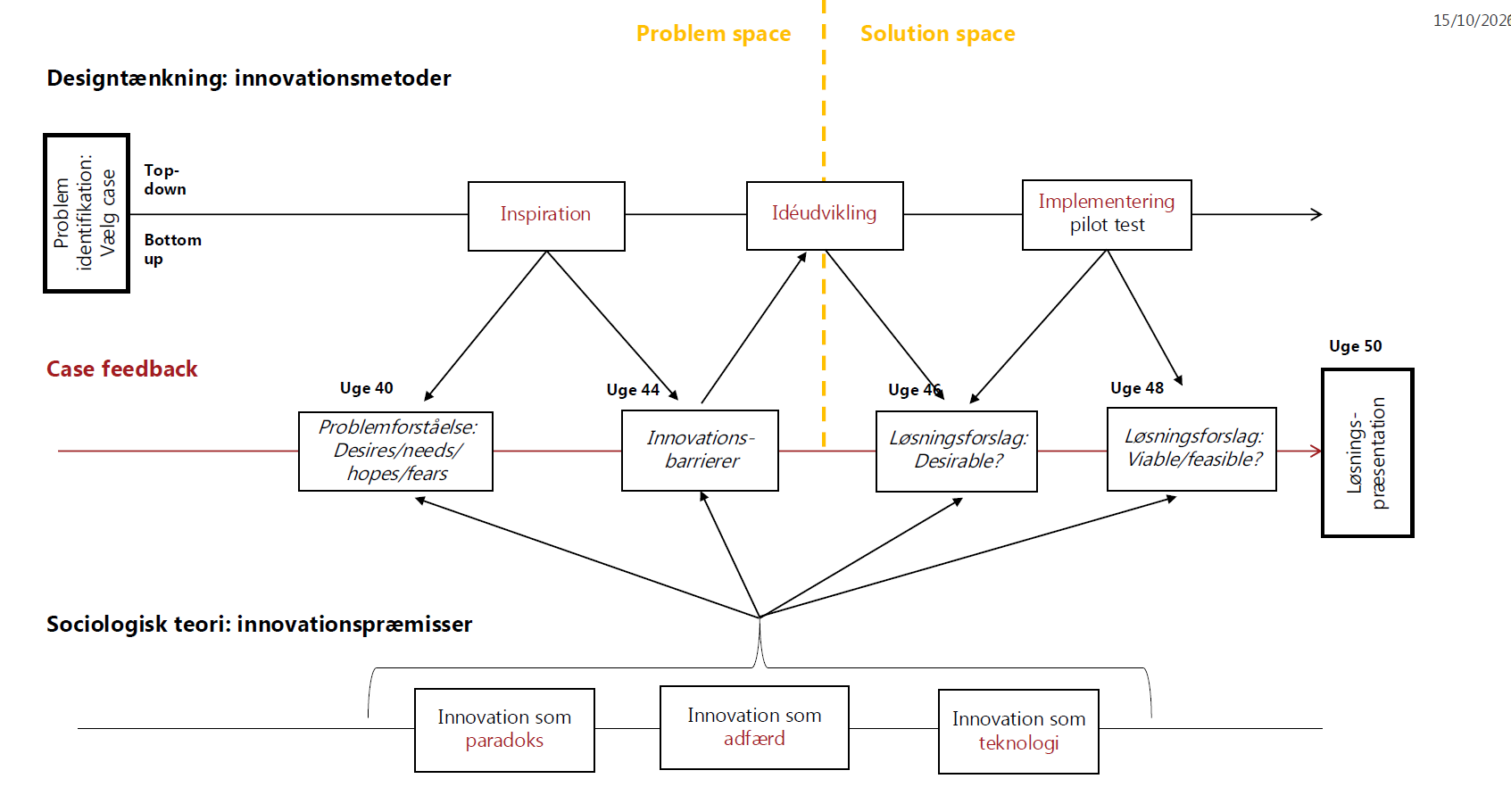
“Sociological Innovation is a mandatory 15 ECTS master's-level course. That corresponds to four hours of teaching per week and approximately 80 students in each cohort,” Ghita explains. “Students begin by selecting a case and forming groups. The course is then organized around three parallel tracks. One track consists of lectures in sociological theory, providing students with an analytical conceptual framework for identifying key mechanisms underlying the problem. A second track consists of workshops structured around design-thinking methods that encourage creative thinking about not yet existing futures. The third track focuses on ongoing presentations, where students present their work and receive feedback from instructors, fellow students, and the case provider. The course concludes with what I call an exhibition, where students present their analyses and recommendations to the case providers.”
Case work requires engagement and alignment of expectations
The cases come from public, private, and non-profit organizations and address a wide range of problems, including waiting times in psychiatric emergency services, high school students’ use of puff bars, creating a sense of home in shelters for people experiencing homelessness, and museum visits by families with children. What all cases have in common is that they represent a social issue within an organizational context. Some cases come through Ghita’s own professional network, while others are sourced through, Copenhagen Health Innovation, CHI, which facilitates contact with healthcare-related case providers in the Capital Region of Denmark.
Over time, the process has become easier. “The course has now been running for three years, and today many previous case providers want to participate again. Other organizations have heard about the course and would like to participate with a case. That is fantastic, and I see it as a sign that the organizations appreciate the students’ work and want more of it.”
“Before a case is accepted, I evaluate whether it is suitable for the course and discuss expectations with the organizations. If the problem is primarily technical or medical in nature, it is not appropriate. The case provider must also have the resources to maintain regular contact with the students and ensure access to data. It is equally important that they are willing to let go of their preconceived understanding of the problem and remain open to the alternative analyses and solutions proposed by the students. Finally, I make it clear to both case providers and students that the students are not consultants, and that student learning remains the primary objective.”
Students can also propose their own cases. “They may have access to a relevant case through a student job or know of organizations working with social challenges they would like to explore. The advantage of allowing students to choose themselves, whether by proposing a case or joining one I have sourced, is that it strengthens their engagement. They are embarking on an intensely challenging process, and motivation is crucial.”
Open learning objectives
One of the greatest challenges of the course is the open learning objectives. “Sociological Innovation is a process-oriented course. It is the students’ reflections on the process that are assessed. Being in this open and experimental learning environment is very different from what the students are used to. ‘We don’t know what we will be able to deliver in the end, yet we will be assessed on it.’ That requires a tremendous amount of confidence and trust in an iterative process that can sometimes feel like one step forward and two steps back. Many students experience considerable frustration during the course, while the real learning often becomes evident only later.”
Ghita addresses this challenge by providing a clear structure and opportunities for feedback on key elements, including project templates, learning journals, and intermediate assignments. “Design thinking is particularly useful because it offers a structured approach to creativity. I also strive to communicate explicitly about the structure of the course. Every week, I explain where we are, why we are there, and what comes next, so students can follow the process. At the same time, I try to make the course fun and playful. Maintaining a playful element can be challenging at a time when many students feel under pressure and grades carry significant weight, but it is important to me to give them a sense of joy in learning. Innovation processes are incredibly fun, so I try to tap into that playful and creative energy.”
Ghita sees evidence of the course’s long-term impact in the fact that many students go on to write their master’s theses in collaboration with external organizations. Former students who have entered the labour market also return with cases on behalf of their workplaces.
A valuable sparring partner
Ghita reached out to KU Lighthouse while developing Sociological Innovation, and the innovation centre remains closely involved. “KU Lighthouse has been a tremendous support because they are responsible for all the design-thinking workshops. They bring highly qualified consultants with extensive experience in using these methods to facilitate innovation processes with students. It has also been invaluable to have sparring partners, especially given that some students experience frustration during the course. It is comforting to have people who understand the process, know that these reactions are normal, and can discuss with me how best to handle them. That support is worth its weight in gold.”

Advice for other educators
Reflecting on the challenges associated with active learning and open learning objectives, Ghita encourages other educators interested in integrating cases and innovation into their teaching to establish early collaboration with the head of studies and colleagues. “This helps ensure that students have the methodological and theoretical scaffolding necessary to work effectively with innovation and open-ended problem cases. I would also add that, because the learning outcomes emerge more slowly than in courses with more direct instruction and formal goals, innovation courses should extend over a longer period than traditional courses. Finally, it is important to consider whether the innovation course should be placed on bachelor’s or master’s level, whether it should be optional or mandatory, and which assessment format best supports process-oriented learning objectives.”
Sociology’s Contribution to Innovation
Sociological Innovation is not only valuable because the innovation field provides sociology with a vocabulary and set of approaches for observing and intervening in emerging futures. According to Ghita, sociology contributes just as much in return.
“I see a huge need to give sociology a voice in discussions about how we develop more sustainable solutions to the complex problems of our time. While innovation trends often favour startups and new technologies, we at the University of Copenhagen have a unique opportunity to mobilise the social sciences and apply a critical lens to societal dynamics and the unintended consequences of how innovation is developed, organised, and implemented. For example, demands for innovation often foster disruption and physical products at the expense of less visible and less glamorous elements such as social processes, maintenance, and routine work. Considering today’s accelerating crises, including climate change, environmental degradation, and mental health challenges, sociology’s focus on infrastructure, power, habits, and values can provide overlooked critical dimensions for developing new collective and sustainable forms of innovation.”
Topics
Contact
Contact Ghita Dragsdahl Lauritzen: gdl@soc.ku.dk
Educator support: https://lighthouse.ku.dk/en/educators/
Proof of Concept Fund, PoC: https://lighthouse.ku.dk/en/researchers/funding/proof-of-concept-pool/